
EU AI Act Article 50: what your website chatbot must tell visitors, and from when
If your website or online store has a chatbot that answers visitors with an AI model, Article 50 of the EU AI Act has applied to it since 2 August 2026. The core rule is short: people must be told that they are talking to an AI system, clearly, and no later than the moment the conversation starts. Most of the work is in the details around it. Who carries the duty when you bought a plugin, or when your developer built the chat on top of a model API? What about AI-written product text and AI-made images? And what did the EU’s Digital Omnibus, published in July 2026, actually change?
This article answers those questions for website and store owners, not lawyers. It is written from the regulation itself and the European Commission’s own pages, which are listed at the end. It is not legal advice. If your chatbot does something unusual, or your business sits in a regulated sector, ask a lawyer who works with the AI Act.
The short answer
- What: an AI system that interacts directly with people must let them know it is an AI, unless that is obvious from the context (Article 50(1)).
- When in the conversation: “in a clear and distinguishable manner at the latest at the time of the first interaction” (Article 50(5)). In practice: in the chat window before or with the first answer, not in a footer or a policy page.
- Since when: 2 August 2026. The Digital Omnibus did not move this date for chatbots.
- Who: the duty is written for the provider of the AI system, the party that builds it and puts it into service under its own name. Depending on how your chat was made, that can be a plugin vendor, or it can be you.
- Fines: breaches of the transparency rules can be fined up to EUR 15 million or 3 % of worldwide annual turnover, whichever is higher; for small and medium-sized companies, whichever is lower.
What Article 50 actually says
Article 50 is the AI Act’s transparency article. It has four duties that matter for websites, and they are aimed at different parties.
| Paragraph | Duty | Who it is aimed at | Relevant for a website? |
|---|---|---|---|
| 50(1) | Systems that interact directly with people must be designed so people are told they are dealing with an AI, unless that is obvious | Provider | Yes: every customer-facing chatbot or AI agent |
| 50(2) | Synthetic audio, images, video and text must be marked in a machine-readable way and be detectable as AI-generated | Provider of the generative system | Mostly for the companies behind the models and image tools |
| 50(3) | People exposed to emotion recognition or biometric categorisation must be informed | Deployer | Rarely; a normal chat widget does neither |
| 50(4) | Deep fakes must be disclosed, and so must AI-generated text published to inform the public on matters of public interest | Deployer | Sometimes: AI images of real people or places, and news-style articles |
Paragraph 5 adds how the information is given: clearly, distinguishably, at the latest at the first interaction or exposure, and in a way that meets the applicable accessibility requirements. Paragraph 1 has an exception: no disclosure is needed when it is “obvious from the point of view of a natural person who is reasonably well-informed, observant and circumspect”, taking into account the circumstances and the context of use.
Do not lean on that exception for a store chat. Most chat widgets look exactly like the live-chat tools that human support staff have used for years. A customer who opens one on a product page has no way to know whether a person or a model is typing. Telling them costs one sentence.
Provider or deployer: who carries the chatbot duty?
The AI Act separates two roles. A provider (Article 3(3)) is anyone who develops an AI system, or has one developed, and places it on the market or puts it into service “under its own name or trademark”. A deployer (Article 3(4)) is anyone “using an AI system under its authority”, outside purely personal use. The chatbot duty in Article 50(1) is written for providers. That makes it worth knowing which one you are. Read against those two definitions, the usual website set-ups look like this:
| How the chat was made | Who is likely the provider of the chatbot | What you do as the site owner |
|---|---|---|
| A ready-made chatbot service or plugin, sold under the vendor’s name | The vendor | You are the deployer. Check that the vendor’s widget discloses AI by default, and do not switch that off or rename it away. |
| A chatbot built for you on a model API (Claude, OpenAI and so on) and run under your brand | Very likely you, since it is put into service under your name. The model company is the provider of the underlying model, not of your chatbot. | Make sure the disclosure is designed in. If an agency built it, it should be in the specification. |
| A vendor’s chatbot that you re-brand and present as your own product | Possibly you, because it is then offered under your name | Treat the disclosure as your own duty. |
In every row, the practical answer is the same: you control your website, so you are the one who can see whether the disclosure is there. If it is missing, it does not help much that the duty was on paper someone else’s.
Does it apply if your business is outside the EU?
Article 2 sets the scope, and it reaches beyond EU borders. The regulation applies to providers who place AI systems on the market or put them into service in the EU, wherever they are established, and to providers and deployers in third countries where the output of the system is used in the EU. A store in the UK, Norway or the US whose chatbot answers customers in Germany or France should plan as if Article 50 applies.
Norway is a special case. The AI Act is an EEA-relevant act, but at the time of writing it has not yet been incorporated into the EEA Agreement or made Norwegian law; the government has said it aims to put the Norwegian AI law before the Storting in spring 2027. A Norwegian site that serves EU customers is still covered through Article 2.
What the Digital Omnibus changed, and what it did not
Regulation (EU) 2026/1744, the “Digital Omnibus on AI”, was published in the Official Journal on 24 July 2026 and is in force. Much of the coverage blurred what it did, so here it is plainly:
- Article 50(1), the chatbot rule, was not changed. It applies from 2 August 2026, as the AI Act always said.
- Article 50(4), deep fakes and public-interest text, was not changed either.
- Article 50(2) got a short transition. Providers of generative systems that were already on the market before 2 August 2026 have until 2 December 2026 to add the machine-readable marking. Systems placed on the market after that date must comply from launch.
- The big delay was for high-risk systems, the AI used for things like hiring, credit or education. Those rules now apply from 2 December 2027 (Annex III systems) and 2 August 2028 (AI in regulated products). A product-advice or support chatbot is not high-risk by itself.
The Commission’s own FAQ on Article 50 confirms the same reading: the obligations apply from 2 August 2026, and the grace period for systems already on the market covers only the marking duty in paragraph 2.
What a good disclosure looks like in a chat window
The regulation does not prescribe wording. The Commission’s FAQ says people should be notified “from the start of the first interaction in a clear and distinguishable manner”. Here is how we did it in the AI shopping assistant we built and tested for BruktTech, our own store for used business laptops, which is a WooCommerce shop in Norwegian:
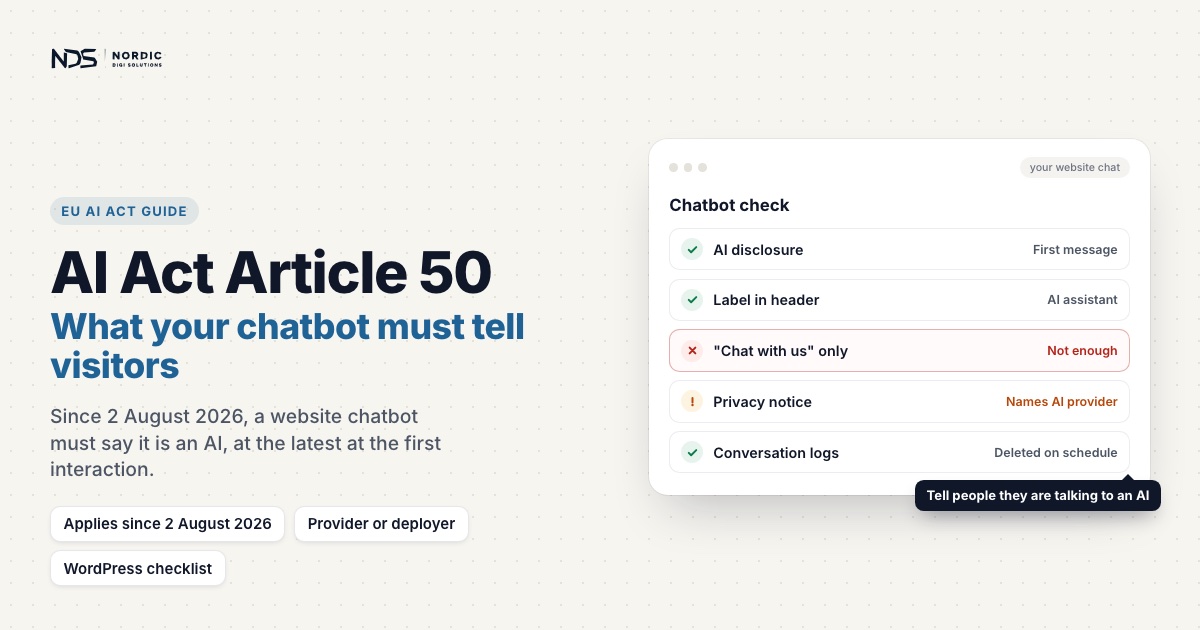
- The first message says what it is. The assistant opens with: “Hei, jeg er BruktTechs AI-assistent. Jeg kan hjelpe deg å finne riktig PC og svare på spørsmål om levering, reklamasjon og IT-hjelp. Hva leter du etter?” In English: “Hi, I am BruktTech’s AI assistant. I can help you find the right PC and answer questions about delivery, complaints and IT help. What are you looking for?”
- The header carries a label. Next to the shop’s name, the chat window shows an “AI-assistent” badge, so the disclosure stays visible after the first message has scrolled away.
- A privacy line sits under the input box. It says, in Norwegian, that the conversation is processed by an AI service (Anthropic) and deleted after 30 days, asks the customer not to type personal data, and links to the privacy notice.
- It is text, not only an icon. Article 50(5) asks for accessible information. A robot icon on its own is not read out by a screen reader in any useful way; a sentence is.
- A person is one click away. The assistant can offer a hand-off to a person by e-mail or WhatsApp. The AI Act does not require this for a chatbot, but customers who know they are talking to a model ask for a person sooner, and that should be easy.
Two WordPress-specific traps are worth checking on your own site. First, the opening message is often a setting in the plugin, and editors change it to sound friendlier (“Hi, I’m Emma, how can I help?”), which quietly removes the disclosure. Second, page caching can serve an old version of the widget’s text for days after you change it. After editing the opening message, purge the cache and test logged out.
AI-written product text and AI-made images
Store owners often ask whether product descriptions written with an AI tool need a label. Under Article 50(4), the text duty covers AI-generated text “published with the purpose of informing the public on matters of public interest”, and even then not when the text “has undergone a process of human review or editorial control and where a natural or legal person holds editorial responsibility for the publication”. Product descriptions are not public-interest information, and on a store someone is responsible for what is published, so Article 50 does not require a label on them. Consumer law still applies to what the text claims about the product.
Images need more care. A “deep fake” in the AI Act (Article 3(60)) is AI-generated or manipulated image, audio or video content that resembles existing persons, objects, places, entities or events and “would falsely appear to a person to be authentic or truthful”. An AI-generated photo of a real-looking person wearing your product, or of your shop’s premises, can fall under that definition, and then the deployer, which is you, must disclose that it is AI-made. A clearly illustrated banner or an obviously artistic image is a different case: for evidently artistic, creative, satirical or fictional work, the duty is limited to disclosing it in a way that does not spoil the work.
The machine-readable marking in Article 50(2) is a duty for the companies behind image and text generators, not for you. Do not strip the provenance data from AI images you download from such a tool, though; it is part of how the system is meant to work.
Guidance from the Commission so far
Two documents sit next to the regulation, and they are often mixed up:
- The code of practice on marking and labelling of AI-generated content was published in final form on 10 June 2026. It is voluntary. On 8 July 2026 the Commission concluded that it adequately covers Articles 50(2), (4) and (5). It does not cover the chatbot duty in Article 50(1), so signing it does not settle your chat window.
- The Commission’s guidelines on the transparency obligations explain how the Commission reads Article 50, including what counts as direct interaction with people. Guidelines are not law, but national authorities read them, and they are the best place to check an edge case.
Checklist for a WordPress or WooCommerce chatbot
Most of this takes an afternoon. The first three points are the AI Act; the rest is the GDPR, which has applied all along and is usually where a chatbot is weaker.
- Disclosure in the first message. Open the chat logged out, on a phone, and read the first thing it says. It should state that it is an AI assistant, in the language the visitor sees.
- A label that stays. A badge or line in the chat header that says AI, so the information does not disappear when the conversation scrolls.
- Accessible text. The disclosure is real text that a screen reader reads out, not only an icon or an image.
- Your privacy notice names the AI provider. Article 13 of the GDPR requires you to tell people who receives their data and why. If chat messages go to a model provider, that provider belongs in the notice, with where the data goes and how long it is kept.
- A data processing agreement with the AI provider. If the provider processes personal data on your behalf, Article 28 of the GDPR requires a contract with it. The large API providers publish standard terms for this; make sure the account the chatbot uses is covered by them.
- Less personal data in, less to worry about. Ask visitors not to type personal data, and if you can, remove phone numbers, e-mail addresses and order numbers from messages before they leave your server. Our own assistant does this; it is best effort, not a guarantee, which is why the window asks as well.
- Logs with an end date. Decide how long conversations are kept and delete them automatically. Ours are stored in the store’s own database and deleted after 30 days.
- A way to reach a person. Not an AI Act requirement for a chatbot, but the honest companion to telling people they are talking to a machine.
- A check after every change. Plugin updates, new opening texts and cache settings can all remove the disclosure. Put the logged-out test in your routine.
If you are adding a chatbot now
The disclosure is the easy part. The harder part is a chatbot that only says what is true about your products, prices and policies, keeps costs capped and handles personal data properly. That is what we build on our AI chatbot for WordPress service, with a fixed scope and price agreed in writing before work starts. For WooCommerce stores, the WooCommerce AI chatbot page shows how the assistant we built for our own store reads live stock and prices, and how we tested it before offering it to others.
Frequently asked questions
Is a chatbot “high-risk” under the AI Act?
Not by itself. High-risk systems are listed in Article 6 and Annex III, for uses such as recruitment, credit scoring, education and access to essential services. A support or product-advice chatbot on a store falls under the transparency rules in Article 50, not the high-risk rules. If your chatbot screens job applicants or decides who gets credit, that changes.
Is “Chat with us” enough?
No. “Chat with us” does not tell anyone that a model, not a person, is answering. Say “AI assistant” or something equally plain.
Does a rule-based chatbot with fixed answers count?
The AI Act covers “AI systems”, defined in Article 3(1) as machine-based systems that infer from their input how to generate outputs. A simple decision tree with pre-written answers may fall outside that definition. A chatbot that sends visitors’ messages to a large language model is inside it.
Who checks this, and how are fines decided?
National market surveillance authorities enforce the AI Act in each member state. Fines for breaching the transparency obligations go up to EUR 15 million or 3 % of worldwide annual turnover; for SMEs and start-ups, the lower of the two applies. Article 99 also requires fines to be effective, proportionate and dissuasive, taking the size of the business into account.
Do I have to change anything before 2 December 2026?
Not for your chatbot: Article 50(1) already applies. 2 December 2026 is the end of the transition for machine-readable marking under Article 50(2), which falls on the providers of generative AI tools.
Sources
Last checked 25 November 2026.
- EUR-Lex: Regulation (EU) 2024/1689 (Artificial Intelligence Act). Article 2 (scope), Article 3 (definitions of AI system, provider, deployer and deep fake), Article 50 (transparency obligations), Article 99 (penalties) and Article 113 (dates of application).
- EUR-Lex: Regulation (EU) 2026/1744 (Digital Omnibus on AI). The transition to 2 December 2026 for Article 50(2), and the new dates for high-risk systems.
- European Commission: Transparency obligations under Article 50 AI Act (FAQ). Chatbots, timing of the disclosure, date of application, grace period and fines.
- European Commission: Code of practice on marking and labelling of AI-generated content. Final code of 10 June 2026 and the Commission’s adequacy assessment.
- European Commission: Guidelines on the transparency obligations. How the Commission reads Article 50.
- EUR-Lex: Regulation (EU) 2016/679 (GDPR). Article 13 (information to the people whose data you collect) and Article 28 (contracts with processors).
- Government of Norway: Tung vil sende KI-loven med endringer på høring (4 August 2026). Norway’s status: not yet implemented, EEA incorporation under way, bill planned for spring 2027.
Related articles
How to Convert Static HTML into a WordPress Theme Without Breaking the Site
AI can generate a good-looking static HTML site in minutes, but forcing it into WordPress with file uploads and .htaccess rewrites breaks routing, plugins, forms and checkout. This 18-step guide shows how to convert static HTML into a proper WordPress theme, with header, footer, enqueued assets, menus and native WooCommerce intact.
Read articleHow AI-Generated .htaccess Rules Can Break WordPress
A single AI-generated .htaccess rule can change how every request reaches WordPress, and break checkout, AJAX, forms or the REST API while the homepage still loads perfectly. Here's why these rewrites are so risky, the mistakes to avoid, and how to review a rule safely before it goes live.
Read articleBefore You Paste AI-Generated PHP into WordPress, Check These Things
AI can write a WordPress PHP snippet in seconds, but pasted in without review it can trigger warnings, break checkout AJAX, cause a white screen, or create redirect loops. Here are the 14 things to check before you paste AI-generated PHP into WordPress, from variable checks and sanitization to hooks, nonces, and a safer placement strategy, with before-and-after code.
Read article